Your clinical will and executor
What a clinical will is, how to name your clinical executor, and exactly what happens to your clients if you die or can no longer work.
From 3 November 2026 the BACP Ethical Framework asks every member, student members included, to have a clinical will and a named clinical executor. Other professional bodies expect something similar. Your clinical executor is a colleague, usually another counsellor, who tells your clients and closes your practice safely if you die or become too unwell to work. For a fuller guide to what the requirement means and how to write your will, see Clinical wills for counsellors.
ForCounsellors helps you set this up, and keeps your client list ready for your executor, so you never have to keep a paper list up to date.
Name your clinical executor
- Open Settings and choose the Clinical will tab.
- Under Your clinical executor, enter their name, email address and how they know you. Talk it through with them first.
- Tick the box that gives us your instruction. It says that if we are satisfied you have died or can no longer work, we may give your confirmed executor your current clients’ names, contact details and next appointment dates, your message for clients and the people to tell in your will, and nothing else.
- Press Save and email them. We email them to explain the role and ask them to say yes.
Your executor’s agreement page shows what you are asking them to do, and they agree to keep everything confidential and use it only to contact your clients and close your practice. You’ll see Confirmed once they say yes.
You can also name a backup executor, who steps in if your executor can’t. Add the person who will raise the alarm, usually your next of kin. We never contact them unless they contact us.
If you’re a student
Students have a clinical will too, and it works the same way, with a few differences because your clients belong to your placements:
- Your executor is usually your course tutor, or your clinical supervisor. If you’ve added your tutor on your Courses page, we fill in their name and email for you, with “my course tutor”. Check the details and talk to them first: nothing is sent until you press Save and email them. If your tutor changes, update your executor on the Clinical will tab; we never change it for you.
- Your executor gets client codes, never names. Your placements hold your clients’ details, so your instruction covers your client codes, the placement each client is with and their next session dates, your placement and course contacts, your message for clients and the people to tell. Your executor tells each placement, which then contacts your clients.
- Your will lists your course and placements. The people to tell include your course and tutor, and each current placement with its phone number and mentor.
- Insurance. BACP student members must hold their own insurance: add yours under Details for your will so your executor can tell them.
- You’ll see a reminder on your dashboard until your executor has said yes, and we check with you once a year that they’re still right.
When you change to a qualified account, check your executor is still right: once you’re in private practice they would receive your private clients’ names and contact details. Save their details again on the Clinical will tab to confirm.
Your will and your release key
Download your clinical will and the one-page summary from the same tab. Keep a copy with your papers and give one to your executor; sign it if you’d like to.
The summary shows your release key, a 12-character code like ABCD-EFGH-JKMN. Keep the summary with your signed will. If something happens to you, your executor needs this key, as well as a code we email them, to see your client list. We never email the key to anyone.
If you think someone else has seen your key, choose Make a new key and print a new summary. The old key stops working straight away.
If your executor loses the key after you have died, we cannot give it to them or make a new one. They can still contact your clients from any records you left them.
What we hold, and what we never share
We hold your client list as you keep it in ForCounsellors. We never give anyone access to your account or your notes: not your executor, not your family, and not us on their behalf. If we hand anything over, it is only your current clients’ names, contact details and next appointments (for a student, client codes and placements instead), your message for clients and the people to tell.
If you die or can no longer work
- Your executor, or your backup, asks us at forcounsellors.com/clinical-executor using the email address they agreed from. We email them a one-time code.
- They send us proof. For a death: a death certificate, a coroner’s certificate, or written confirmation from your personal representatives. If you can no longer work: your executor’s account of what has happened, plus one of these: a letter from your doctor or hospital, a registered lasting power of attorney or deputyship order, or confirmation from a member of your family, whose identity we check.
- We email you straight away, and every day after, and show a message at the top of every page in the app. You have 3 or 7 days to stop it, whichever you chose in Settings.
- To stop a false request, press Stop this: I’m fine. If you sign in but don’t press it, we pause the request and one of our founders contacts you before anything goes further.
- After that time, two of our founders check the request and the proof. Both must agree.
- Your executor gets a link to a secure page with your current client list. It stays open for 90 days.
- We stop your subscription charges.
What happens to your clients
Only your executor contacts your clients. We never email a client to say that you have died or are unwell.
If your executor asks us to, we cancel your upcoming sessions and booking requests. Clients who booked online get our usual cancellation email, with no reason given, and nobody is charged for a cancelled session. Your executor can also ask us to take your website down.
Your clients’ records stay in your account, untouched, until the account is closed and deleted under our usual retention rules. Nothing is passed to anyone else.
For clinical executors
You need:
- the email address you used to agree to be their executor;
- proof of what has happened, such as a death certificate;
- the release key from their clinical will summary, kept with their signed will.
Go to forcounsellors.com/clinical-executor and tell us what has happened. We email you a code, then ask for your proof. The counsellor is told and has a few days to stop the request. Then two of our founders check it. If all is in order, we email you a link to a secure page.
Each time you open the page, we email you a fresh code, and you type in the release key. The page shows the counsellor’s current clients, their contact details and next appointments, the counsellor’s message for clients, the people to tell and their will. You can print it. It never shows notes. It stays open for 90 days.
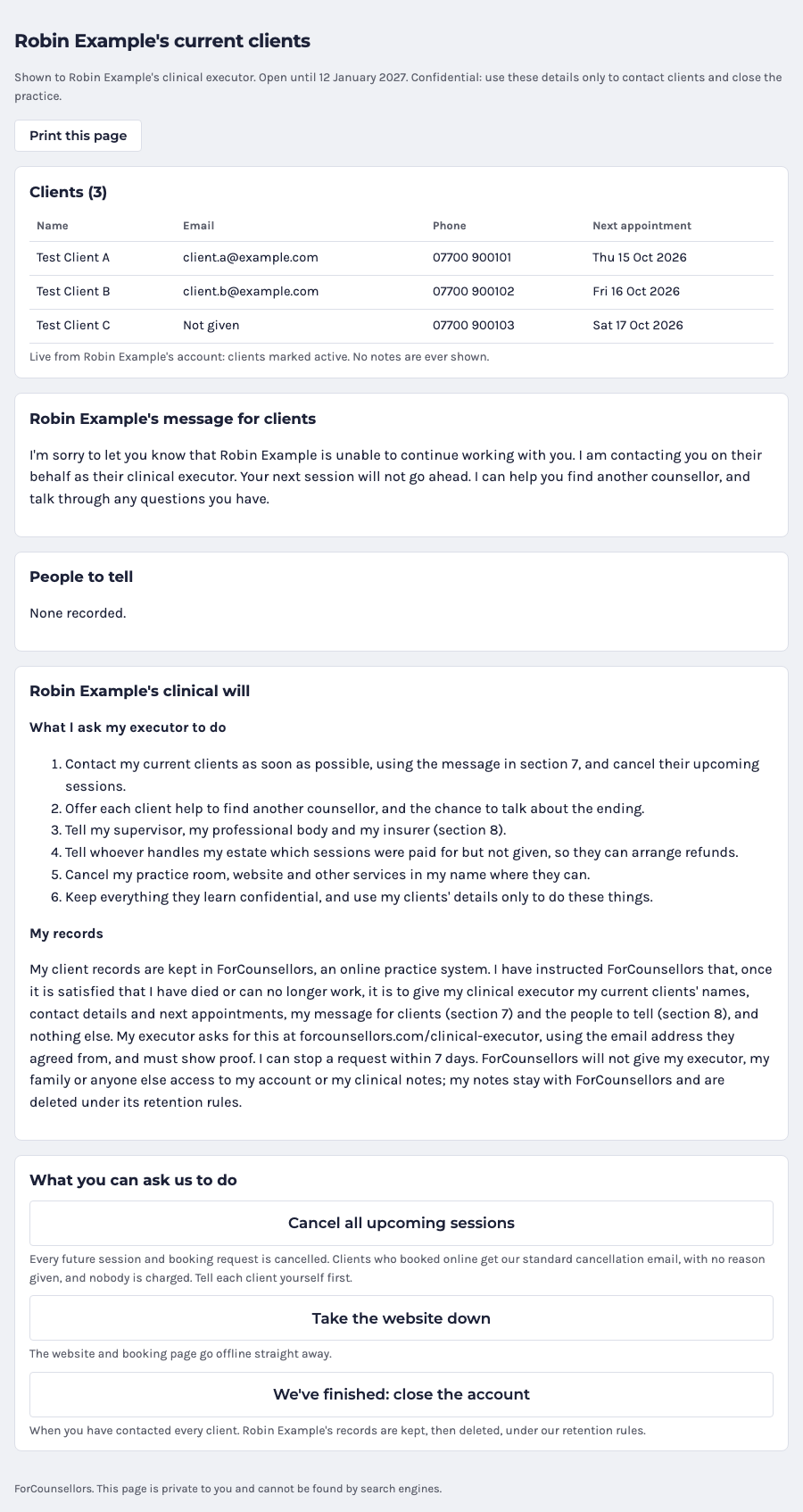
From the page you can ask us to cancel all upcoming sessions, or to take the counsellor’s website down. Please tell each client yourself first.
If the counsellor is a student, the page lists their clients by code, grouped by the placement each client is with, with each placement’s phone number and mentor. Please tell each placement: they hold the clients’ details and will contact them. There are no buttons to cancel sessions or take a website down, because the placement looks after those.
If the page says the service is not open yet, email support@forcounsellors.com and we will help you.